History of Radio Astronomy
This page collects historical materials on radio astronomy, with particular attention to the Torun and NCU tradition of radio astronomy.
Selected worldwide milestones
Early attempts to detect solar radio emission around 1900 were unsuccessful. The field then moved through Karl G. Jansky’s 1931 detection work, Grote Reber’s 1937-1944 radio telescope and Milky Way maps, Stanley Hey’s 1942 detection of solar radio emission, the 1944 theoretical prediction of the 21 cm HI line and its independent detections in 1951, the development of interferometry and aperture synthesis at Cambridge in the 1950s, the first use of VLBI in 1960, the discovery of the cosmic microwave background in 1965, pulsars in 1967, and later large facilities such as Jodrell Bank, Arecibo, Effelsberg, the VLA, VSOP, and the new projects of the 1990s.
Torun and NCU milestones
In Torun and at NCU, W. Iwanowska initiated the Radio Astronomy Team in 1956, RT1 was built in August 1957, and the first detection of solar radio emission at Torun was made on 6 February 1958. RT2 was built and used in 1958-1960, S. Gorgolewski went to Cambridge on a British Council grant in 1958-1959, the first Polish Ph.D. in radio astronomy was completed in 1960, and the Radio Astronomy Chair at the NCU Institute of Astronomy was established in 1965. In 1970-1973 A. Kus carried out the 43 MHz circumpolar survey as the first aperture synthesis in Poland. RT3 was commissioned in 1979, Torun joined VLBI on 29 June 1981, and RT4, the 32 m radio telescope at Piwnice, entered full operation in 1996.
NCU and Torun background
The broader institutional background began with the arrival in Torun of astronomers from Stefan Batory University on 15 July 1945. Nicolaus Copernicus University was established on 24 July 1945, the Astronomical Observatory was created in 1945, the Institute of Astronomy in 1952, and a new observatory building was completed in 1954. The early Torun radio astronomy effort focused on systematic monitoring of solar radio activity, first with RT1 and RT2 and later with a dedicated solar interferometer operating from 1960.
Copernicus anniversary and the move toward VLBI
New radio astronomy buildings in Piwnice were completed in 1973 for the Copernicus 500 anniversary as the first step towards a National Radio Astronomy Centre, originally planned around a 5 x 25 m synthesis array. The same anniversary year also saw the launch of the Copernicus 500 satellite with a 1-10 MHz spectrometer designed and prototyped at NCU.
RT3, VLBI, and RT4
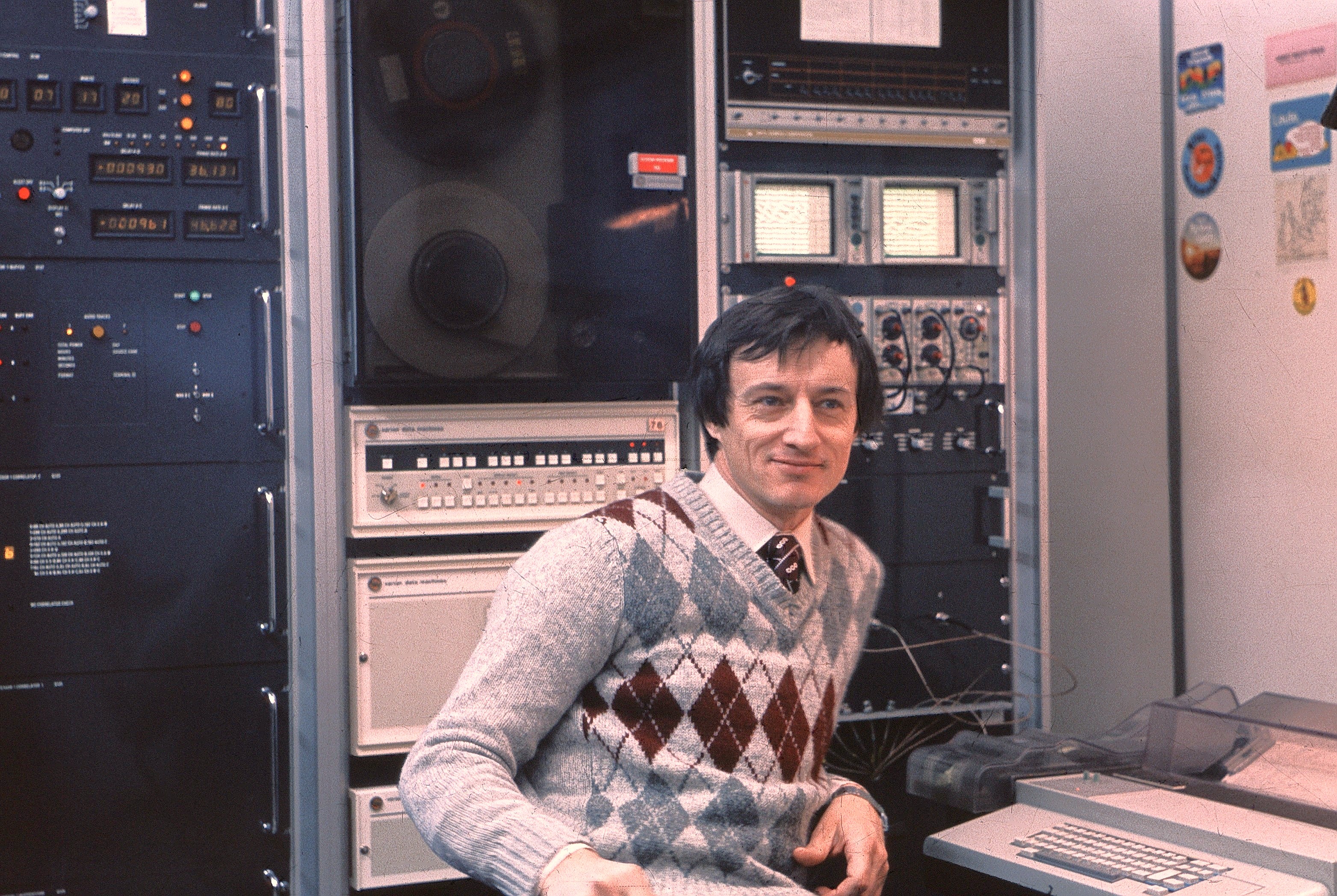
RT3 was commissioned in 1979. On 29 June 1981 Torun achieved its first successful VLBI observations, and the same RT3 period brought the first successful Torun observations of pulsars, neutral hydrogen, and OH. For RT4, the first VLBI fringes came in May 1996 and full scientific operation began later in 1996, followed by regular pulsar timing and spectral work. Later stages included participation in VSOP and the appearance of OCRA among the major 21st-century projects.
Basic facts and milestones
History of Radio Astronomy: Basic Facts and Milestones
History of Radio Astronomy Research at NCU
History of Radio Astronomy Research at NCU
Radio astronomy in Poland
Radio Astronomy in Poland
Astronomy at Nicolaus Copernicus University
Astronomy at Nicolaus Copernicus University
Polish only.